What a fender line does
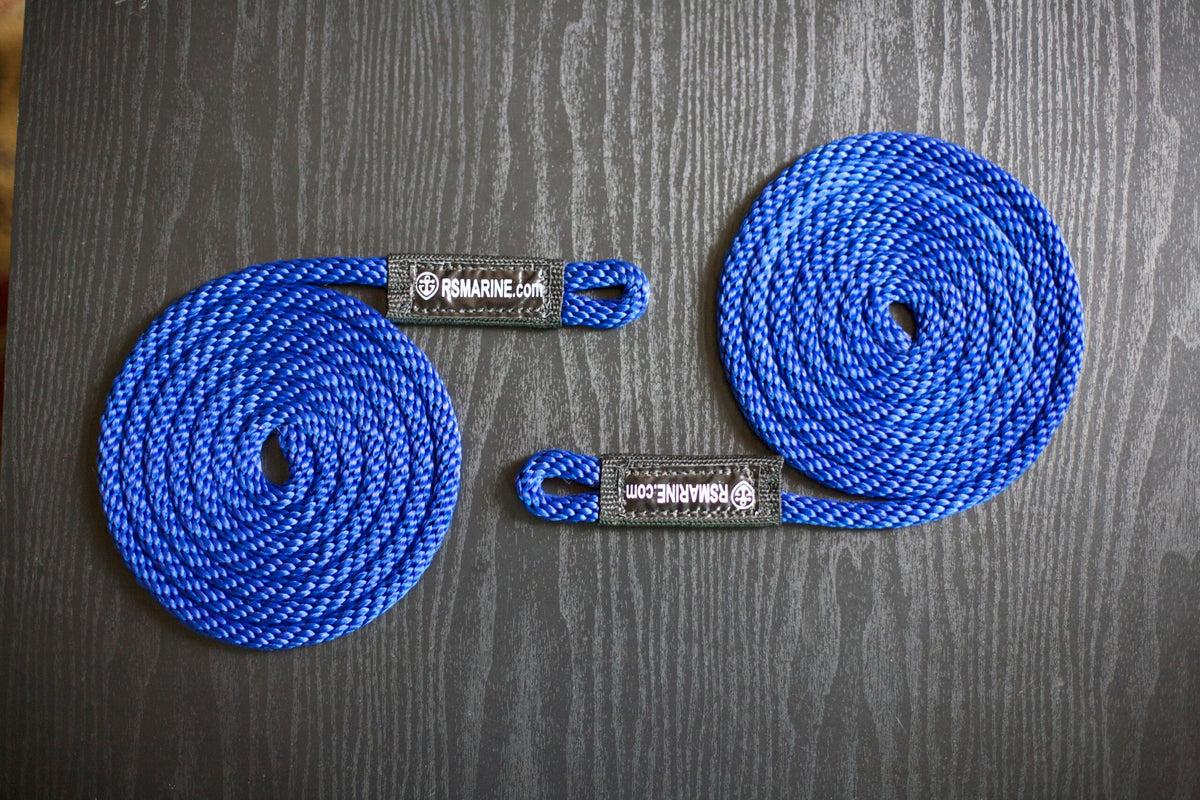
A fender line connects the fender to the boat, usually to a rail, a stanchion base, or a cleat. Its job is to hold the fender at one fixed height while the boat rises, falls, and rolls against the dock. That sounds simple, but the line takes a beating: it rubs on the rail, gets wet and dries over and over, and is tied and untied every time you dock.
Most boaters start with whatever spare rope is aboard. The usual result is a frayed end that will not go through the fender eye, a knot that jams, and lines of three different lengths so the fenders never hang level. A set of matched, dedicated fender lines fixes all three.
Diameter: 3/8 in or 1/2 in
Pick the diameter by the size of your boat. A common rule for boat lines is about 1/8 in of diameter for every 9 ft of boat length, and fender lines follow the same logic: a heavier boat loads the fender harder, so it needs a thicker line.
- 3/8 in: boats up to about 25 ft. Runabouts, bowriders, center consoles, most pontoons, and small cruisers.
- 1/2 in: boats from about 25 to 35 ft, or a heavier boat under 25 ft, such as a trawler-style hull or a loaded cabin cruiser.
Between the two? Choose the thicker line. It costs little extra, lasts longer, is easier to grip with wet hands, and has more margin when wind or wakes push the boat hard onto the dock. If your fender eyes are small, check that the line will pass through before you buy.
Length: 5 ft or 7 ft
Pick the length by how high you tie off above the water. The line has to reach from the rail or cleat down to where the fender should sit, with enough left over for the knot at the top.
- 5 ft: rails and cleats that sit fairly close to the water, typical of runabouts, bowriders, and pontoons.
- 7 ft: higher rails and cleats, or when you want spare line to reset fender height at fixed docks and as the tide changes.
To check, measure from where you tie off down to where the fender should sit, then add about 2 ft for the knots. If the number lands between the two lengths, take the longer line. Extra line is easy to take up in the knot; a line that is too short cannot be fixed at the dock.
How many fender lines do you need?
One line per fender, plus a spare. A common rule of thumb is one fender for every 10 ft of the boat’s length, and never fewer than three on the side you dock on: one near the widest point of the hull, one forward, and one aft.
If you dock on either side, or raft up with other boats, carry enough fenders and lines to set up both sides. It is much easier to move a fender line that is already tied on than to hunt for rope during the approach.
How to hang a fender at the right height
- 1
Attach the line to the fender
Pass the eye end through the fender’s eye and pull the line through the loop. No knot is needed at that end when the line has a ready-made eye.
- 2
Find the rub point
Look at where the hull will touch the dock or pilings. On most boats that is the widest part of the hull, a little above the waterline at a floating dock and higher at a fixed dock.
- 3
Set the height
Hang the fender so it covers the rub point, with its bottom just clear of the water. A fender dragging in the water does not protect anything.
- 4
Tie off to something solid
Make the line fast to a rail, stanchion base, or cleat. On a cleat, use a cleat hitch. Avoid tying to lifelines, which can stretch and let the fender drop.
- 5
Check again alongside
Once you are tied up, look again. Wakes, tide, and a crew member stepping aboard all change how the boat sits, and a quick adjustment now saves the gelcoat later.
Tired of retying? Quik Fender holds your fender line on the rail with no knots to tie: the line wraps the rail, the fender hangs below, and one tug locks it at the height you set.
Why whipped ends and a ready-made eye matter
Cut rope frays, and a frayed end will not feed through a fender eye or a rail fitting. Whipping binds the end so it stays neat for the life of the line. A ready-made eye means one end is already finished, so the only knot you tie is the one at the rail or cleat.
Take fenders in once you are underway. Fenders left hanging bang against the hull, chafe their lines, and are the first thing to go over the side in a wake.
Our fender and boat lines
Fender and Boat Lines from RS Marine come pre-cut and professionally whipped, with a ready-made eye, in 3/8 in and 1/2 in diameters and 5 ft and 7 ft lengths. They are sold as a 2-pack, in 15 colors so you can match the lines already on your boat.
Fenders protect the hull once you are alongside. Getting alongside is the other half of the job: The Boat Loop® lets you reach the cleat from aboard and draw the boat in, so you are not leaning over the rail while the fenders do their work. For the full routine, read how to dock a boat by yourself.
Safety notes
WARNING: Read before use. Improper use of The Boat Loop® can cause injury or death.
- The Boat Loop® is a docking aid only; never use it as a permanent mooring line.
- Never place the loop over or around anyone’s neck. Strangulation could occur.
- The Boat Loop® is not a lifesaving or rescue device. Never use it to pull a person from the water; throw a life ring or other approved throwable flotation device instead.
- Do not exceed 100 lb of pulling force or 75 lb of pushing force. Exceeding these limits can damage the product or cause injury.
- Reduce force when the pole is extended; the fiberglass pole is more susceptible to buckling under heavy pushing at full extension.
- It floats only when the Extension Pole is extended at least 12 inches, so do not rely on it as a flotation device.